

26 August 2010 - 9:50Time and Time Again

Ever stop to wonder where the time went? What happened in your life that got you from a proverbial “then” to a sometimes all-too-tangible “now”? Well, we all do, but this Time magazine list of the “Top 10 Things Today’s Kids Will Never Experience” will have you feeling as old as the tan-colored M&M’s you wish were still around. Even so, it never hurts to relive the glory days.

Our favorites from the list? Camera film (remember standing in a dark closet to take it out of the camera without overexposing it? And waiting until the roll was done to have the drugstore develop it?), music videos on MTV (Jersey what?), and being lost (GPS=Goof-Proof inStructions on how to get anywhere).

Being a generation y-er myself, I’d also have to add colored popcorn, the Backstreet Boys, and scrunchies to the list. Oh, scrunchies. I guess there are some things this generation is better off without..

No Comments | Tags: Weird & wild
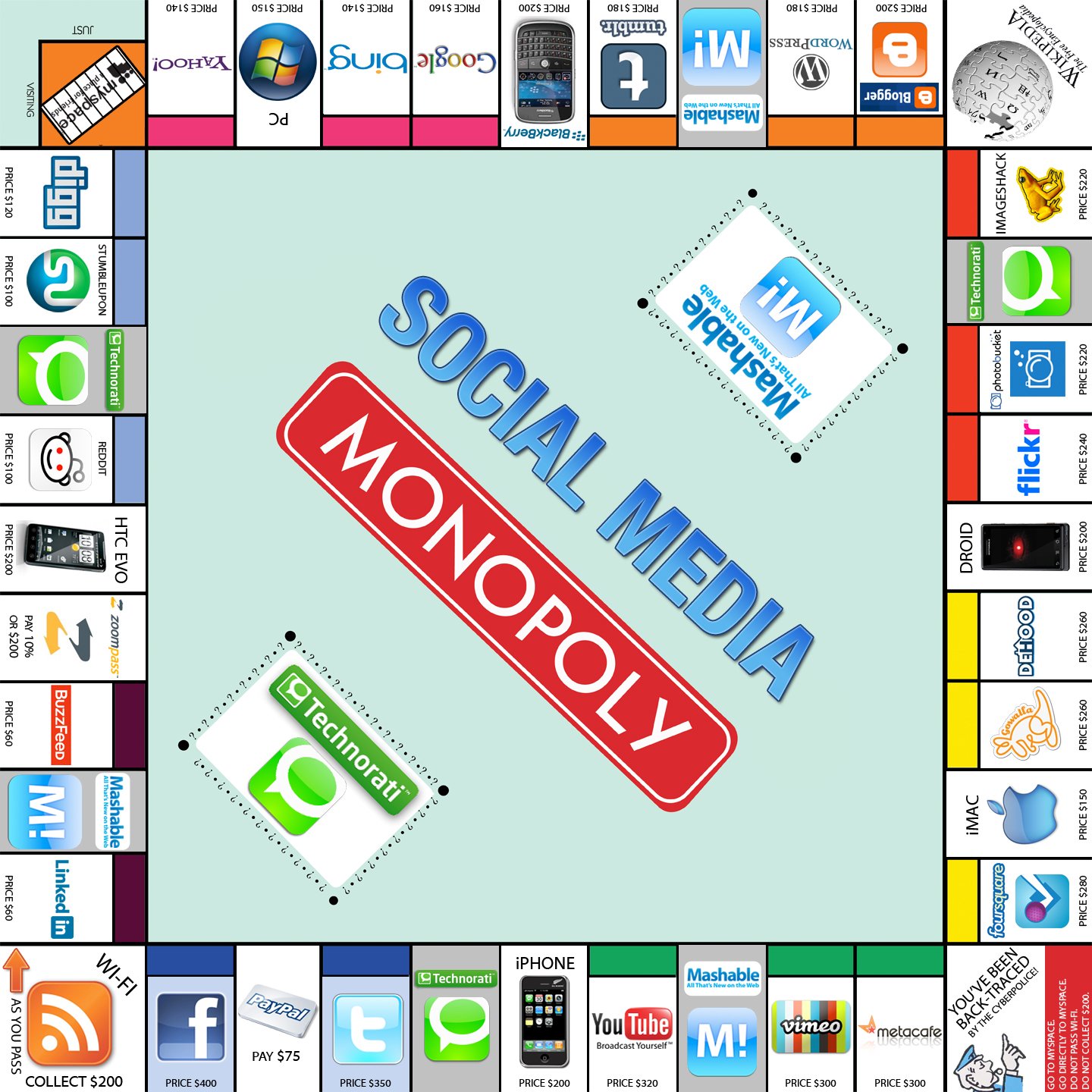
21 August 2010 - 9:32Social Media Monopoly

If social media were a game, the folks at The Big Picture think it would look a little something like this..

Image Courtesy of ritholtz.com

It seems fitting that Facebook (with its 500 million users and recent launch of the Facebook Places app) is the original Monopoly’s Park Ave equivalent and Wikipedia is Free Parking. Touche, Mr. Ritholtz. We’ll take two, please!

No Comments | Tags: social media, Weird & wild

13 August 2010 - 10:25The ABC’s of Internet Lingo

With the influx of social media over the last several years has come a laundry list of new terminology. In today’s internet-centric society, you can “google” the answers to your questions, “friend request” your acquaintances, and “tweet” your everyday thoughts. You can “LOL” when someone tells you a joke, “inbox” a message you want to keep private, and “follow” your friends and favorite celebrities. It is said that on June 10, 2009, the English language even passed the “million word threshold” when the term “Web 2.0″ became officially recognized. So how can you keep up?

Fortunately, along with the increase in verbiage has come an increase in online and street-slang dictionaries, as well as a number of tutorials on how to put the terms to use in the context of the social media from which they were derived. Below are our favorites.

1. A Guide to Internet Lingo and Emoticons. This one is old school. Remember the days when the internet was called “The Net” and you were still learning how to send “electronic-mail”? This is a tutorial from then. Here’s a taste: “:) is one of the most popular emoticons, used to represent a smiley face. If ‘:)’ still doesn’t make sense, tilt your head to the left.” Love it.

2. How Do I Facebook? A non-Facebook endorsed (but dead-on) glossary of Facebook terms from “admins” to “news feeds” to “pokes.”

3. Twitterspeak. Posted on Mashable.com, this list is incredibly thorough and even touches on some terms we hadn’t heard of. “Tweepish,” “tweetheart,” and “twideo-cronicity” all make the cut.

4. Twitter Terminology 101. For those looking to set up a Twitter account, not rule the world with it.

5. LinkedIn Glossary. A list of terms for employees and employers looking to network in a professional setting, this site explains the varying degrees of “connections” and the difference between an “InMail” message and an “OpenLink” one.

Happy studying, everyone! Quiz is Tuesday.

No Comments | Tags: social media

7 August 2010 - 10:40Surprising Social Media Stats

There’s a lot of hubbub these days about the increasing ubiquity of social media, but the following statistics will bring your understanding of this media form’s depth of reach to an entirely new level. Danny Brown, a social media and marketing consultant and partner at Bonsai Interactive, recently compiled a list of 52 facts (one for each week of the year) about the five most well-known social media outlets—Facebook, Twitter, LinkedIn, YouTube, and RSS. Here’s a taste:

1. More than 25 billion pieces of content (web links, news stories, blog posts, notes, photo albums, etc.) are shared on Facebook each month.

2. There are more than 100 million active users currently accessing Facebook through their mobile devices (and they’re twice as active as non-mobile users).

3. More than 300,000 new users join Twitter every day.

4. Twitter receives 180 million unique visits each month.

5. There are more than 70 million LinkedIn users worldwide, coming from over 200 countries and covering every continent.

6. Eighty percent of companies use LinkedIn as a recruitment tool.

7. To watch all the videos currently uploaded on YouTube, you’d need to live over 1,000 years.

8. YouTube receives more than 2 billion viewers per day.

9. Seventy-seven percent of internet users read blogs, and the leading blog directory lists over 133 million unique blogs.

10. Corporate blogging accounts for 14 percent of all blogs.

Those should get you almost through October, but for more social media statistics and Brown’s complete list, click here.

No Comments | Tags: social media

2 August 2010 - 11:55Free Microblogging or Bust

A recent study by USC’s Annenberg School for Communication and Journalism found that while nearly half of all Americans have used free microblogs like Twitter, a whopping ZERO percent of them would be willing to pay for them. Not exactly good news for startup companies hoping to launch subscription-based networking sites. Or for existing sites looking for alternatives to advertising as a revenue stream.

“Such an extreme finding…underscores the difficulty of getting Internet users to pay for anything that they already receive for free,” Jeffrey Cole, director of the Center for the Digital Future at USC, explains. ”Twitter has no plans to charge its users, but this result illustrates, beyond any doubt, the tremendous problem of transforming free users into paying users.”

What else was discovered in the study? That 70 percent of Internet users find online advertisements “annoying,” for one. And 50 percent claim never to click on such advertisements. For internet startups and old hats alike, this means that an inventive and consumer-friendly solution is crucial for solving the wicked problem web apps have of attaining both fortune and fame.

“Beginning with our first Digital Future Study in 2000, and in every year since, we have found extraordinary levels of shifting views, new and evolving attitudes about technology, adoption of new media, and casting off of old methods as part of involvement – or not being involved — in the online experience,” Cole has said. So where will the virtual world turn next? Can you keep up?

No Comments | Tags: social media, Uncategorized